PORTFOLIOf(x) Capital Portfolio Optimiser, finds the portfolio of projects that delivers the greatest value with the least impact on production.
Every project in your backlog earned its place. It clears a threshold, addresses a risk, or improves performance. The real question isn't "Is this a good project?" — it's "Is this the best portfolio we can build?".
The best individual projects don't always create the best portfolio. Production impacts, resource constraints and available campaign windows change the project value equation, requiring trade-offs that aren't visible when each project is evaluated in isolation.
The problem is scale. Even a modest backlog generates thousands of possible project combinations, far too many to evaluate manually with any confidence.
The real question isn't "Is this a good project?" — it's "Is this the best portfolio we can build?"
Fig 01 — Same budget, same projects. Different portfolio decision.
PORTFOLIOf(x) uses mathematical algorithms to find the optimal combination of projects that delivers the greatest business value while respecting budget, shutdown, resource and production-loss constraints.
PORTFOLIOf(x) models your production process to reveal the hidden cost of portfolio decisions: lost production. By quantifying downtime impacts and balancing them against value, budget, resource, and shutdown constraints, it identifies portfolios that maximise total business value, not just project scores.
What the model captures
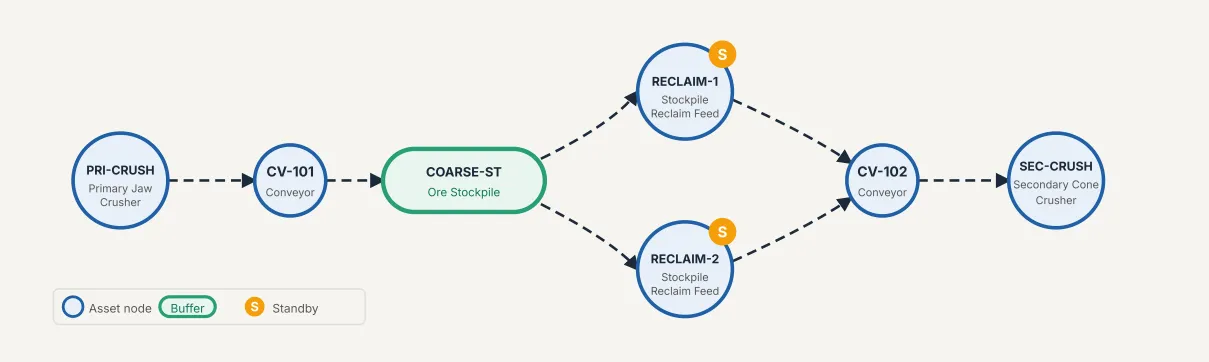
Fig 02 — The asset process flow models project interactions for production downtime evaluation and project selection.
Assess each project against your value metrics e.g., financial return, safety, ESG and operational continuity. Weight against your strategic priorities to produce a single, comparable priority score.
Build a flow model that captures how assets combine to deliver production revenue: what's critical, where standby exists, how buffers absorb downtime, how utility failures propagate.
Evaluate hundreds of thousands of project combinations to find the highest-value solution within budget, shutdown, resource and production-loss limits. Don't rank, search.
Review value vs budget, value vs production loss, and portfolio sensitivity to assumptions. Flag marginal projects, identify robust ones. Compare results to reach your preferred solution.
Find the best combination of projects based on your objectives and constraints.
Quantify the production loss for every combination of projects.
Generate board-ready executive summaries and justifications for every project decision, automatically.
Test alternative budgets, priorities and constraints in minutes, not weeks.
Evaluate how sensitive the results are to changes in criteria weightings and assumptions.
Draft → Review → Submit → Approve → Execute, with full audit trail.
An objective narrative engine that proves the robustness of your portfolio choices with hard data evidence.
A detailed report on why each project was selected, deferred, or rejected, the portfolio robustness, and clear recommendations ready for submission, grounded strictly in your run's own numbers.
"Project Deferral Explanation: IOB-PROJ-069 Structural steel remediation was deferred due to two binding constraints: 1. Budget exhaustion: Only $465,000 remains of the $11M budget, but this project requires $540,000. 2. Fitter hours ceiling: The portfolio already uses 3,480 of 3,500 available hours; this project needs 320 more, exceeding capacity by 80 hours. The trade-off: Including this project would require dropping four lower-ranked bearing overhaul and cyclone reline projects (TOPSIS scores 0.202–0.313). Although those four projects total only $725,000 in spend versus the $540,000 needed, their combined portfolio value outweighs the single project's contribution. To enable this project, either increase the fitter hours ceiling (primary constraint) or reallocate budget by explicitly deferring those four lower-value projects."
Binding constraints and trade-offs in plain language.
Monte Carlo confidence check, explained in words.
What changed between two scenarios, and why.
Your provider, your API key, encrypted at rest.
Connect any MCP-compatible agent directly to your portfolio and interact with your project data and dive deep into your portfolio and solver decisions.
Whether you're evaluating projects for a process plant, a mobile fleet or a linear network, PORTFOLIOf(x) has the right model to find the highest-value portfolio within your budget.
In a process plant, every asset is part of a connected production chain. Taking one asset offline can affect everything downstream through process flow, utilities, standby equipment and shared dependencies.
PORTFOLIOf(x) models your plant as it actually operates. Production impacts are calculated from the real asset connections, so every project's value reflects the true cost of taking equipment offline.
Unlike fixed assets, vehicles operate as a shared pool. Removing several vehicles for maintenance does not always reduce production. The real constraint is often workshop capacity and how many major jobs can be completed at the same time.
PORTFOLIOf(x) models fleets against production targets and real workshop constraints. Maintenance schedules reflect what can actually be delivered while balancing production, labour and workshop capacity.
Roads, pipelines and rail corridors do not always need to be completely closed during maintenance. Sections can often remain partially operational, reducing production impact and creating more scheduling flexibility.
PORTFOLIOf(x) models linear infrastructure as connected segments, allowing projects to keep parts of the network operating where possible. The optimiser values partial closures accurately instead of assuming every project requires a full shutdown.
Bring a recent planning cycle. We'll model your topology and show the optimised portfolio side-by-side with your current plan.
Portfolio f(x), Capital Portfolio Optimiser
info@portfoliofx.io · portfoliofx.io